Energy Insights
Understanding Energy & the Midstream Industry
Explore quick facts, common questions, and key insights about how energy works.
Myth: If you live near a pipeline, the air isn't safe.
Fact: It is safe to live, work, and breathe near a pipeline.
By design, pipelines are enclosed systems that prevent resources from reaching the outside air. Midstream companies have made enormous progress in preventing leaks and improving operational safety. In addition, PHMSA regulates U.S. pipelines, overseeing integrity management programs, regular assessments, and enhanced precautions in populated areas.
Categories
Are pipelines the safest way to move energy?
Yes. According to PHMSA, 99.999% of oil and gas products moved by pipeline safely arrive at their destination without incident.
For midstream companies, safety and efficiency are top priorities. Midstream works with the Pipeline and Hazardous Materials Safety Administration, part of the U.S. Department of Transportation, to ensure pipeline safety. The result is a system that moves enormous amounts of energy quietly, efficiently, and safely every day.
Categories
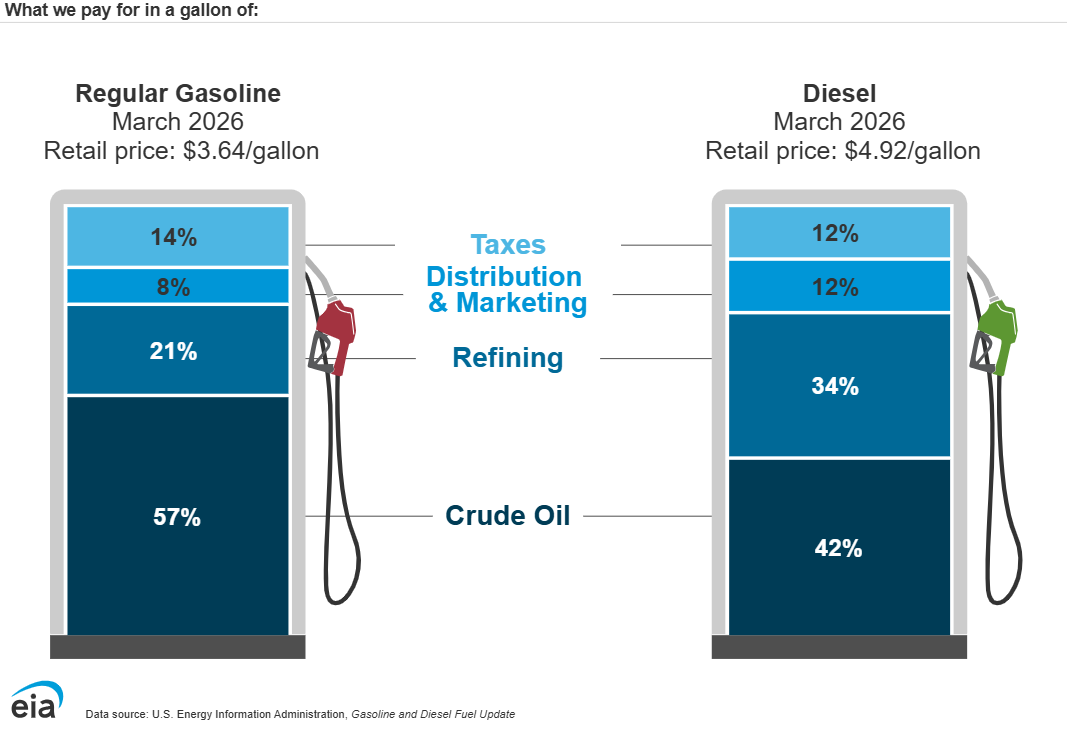
Here’s what you are actually paying for at the pump.
That price at the gas station is made up of four things: crude oil, refining, distribution and marketing, and taxes.
Currently, crude oil alone accounts for 52% of the price of a gallon of regular gasoline. Taxes make up 18%, refining 17%, and distribution and gas station operations 13%. So when prices spike, the biggest driver is almost always the global cost of crude.
Categories
Myth: Pipeline construction permanently damages the land.
Fact: Land disturbed during pipeline construction is restored as closely as possible to its original condition using modern, approved techniques. For agricultural land, restoration is required by law.
Categories
What is midstream actually doing to reduce methane emissions?
A lot. Midstream operators monitor operations, fix leaks, and invest in new technologies. They report emissions to federal and state agencies, as well as investors.
New tools, including satellites, drones, and ground sensors, are improving detection in real time. GPA Midstream has a technical committee focused entirely on measuring and reducing greenhouse gas emissions from midstream facilities.
Categories
Does the midstream industry care about the environment?
Yes. Midstream operators work closely with landowners, local communities, and regulators to minimize environmental impact at every stage.
The industry is pushing for greater transparency through emissions reporting, and is investing in technologies to monitor and reduce emissions. Being a good neighbor is built into how midstream operates.
Categories
